

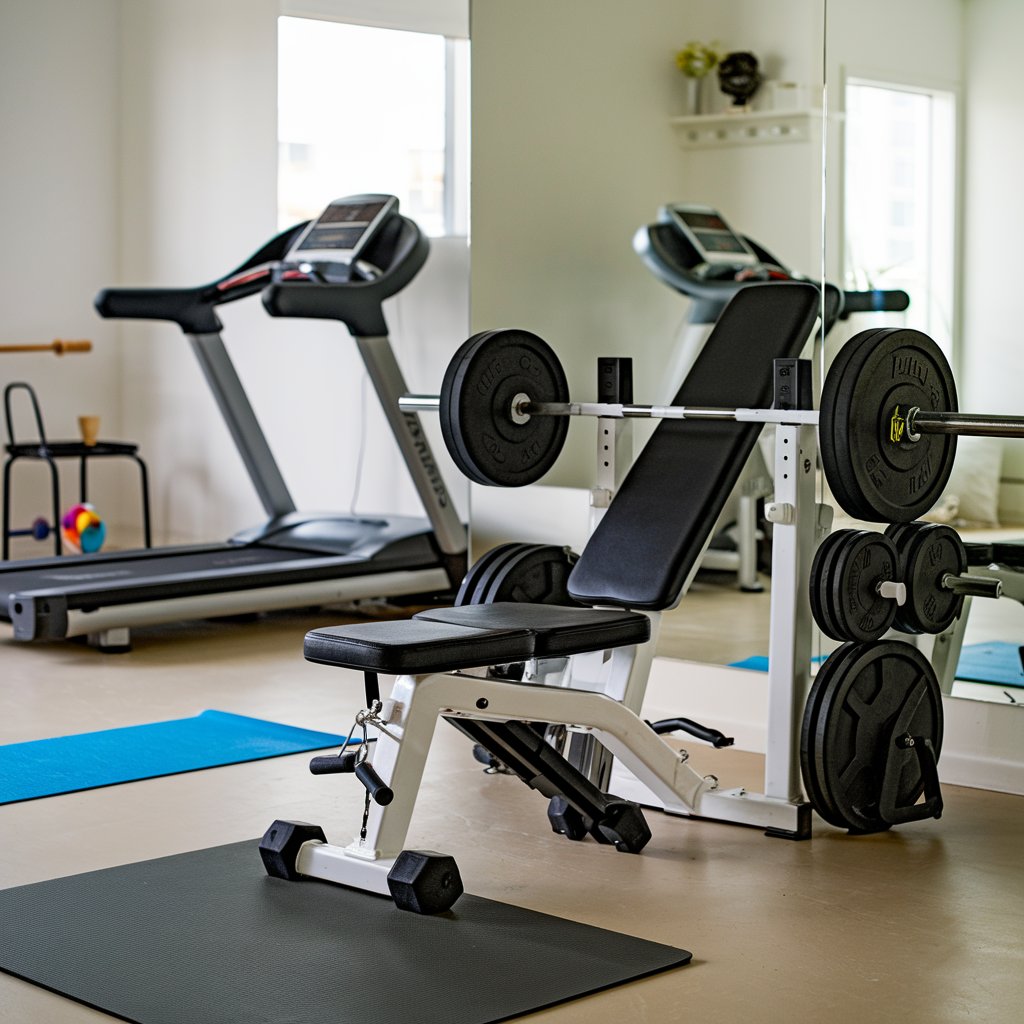
Whether you’re looking to save money on gym memberships, want more flexibility with your workout schedule, or just prefer working out in the privacy of your own home, setting up a home gym can be extremely rewarding. With some strategic planning and key equipment purchases, you can construct a home gym that rivals commercial gyms and supports a wide variety of high-intensity workouts.
The Foundation: Barbell, Weight Plates, Bench
No home gym is complete without a barbell, weight plates, and flat bench. This powerlifting trio forms the backbone of any serious strength training program and allows you to perform compound exercises that target full body movements.

A quality Olympic barbell with the capacity to hold several hundred pounds is key. Look for one made of steel with smooth knurling to provide a sturdy but comfortable grip. Make sure to purchase weight plates in incremental increments, typically 5, 10, 25, 35 and 45 pounds each, so you have flexibility to progress your lifts over time.
An adjustable bench that supports flat, declined and inclined positions opens up an even greater variety of barbell chest, shoulder and triceps exercises. Opt for a wide, padded surface with safety features like adjustable leg holds for maximum security. With these three items, you’ll be set to perform the staple exercises like bench press, shoulder press, squats, deadlifts, and more.
Dumbbells: Multipurpose Movements
While barbells certainly pack a powerful punch, dumbbells offer unique benefits that make them a must-have for any home gym. Their versatile nature allows you to perform both unilateral and bilateral exercises to target each side of your body independently. This focus on weakness and muscle imbalances results in better symmetry and injury prevention.

Consider starting with a set of adjustable dumbbells that come in one compact package. Brands like Bowflex offer selections of plates that quickly convert dumbbells into various weights. This saves considerable space in your home gym compared to racks of individual dumbbells.
With dumbbells in hand, you can perform rows, lunges, shoulder presses, bicep curls, triceps extensions, and countless other moves to sculpt a well-balanced physique. Their portable design also makes dumbbells ideal for supersetting compound and isolated lifts in circuit-style training.
Pull-Up Bar: Total Upper Body Builder
While push exercises like bench presses develop the chest, triceps and shoulders, you need a dedicated way to train pulling motions for upper body balance and injury prevention. Enter the simple yet effective pull-up bar.

Mounted on a sturdy frame inside a power rack or attached securely to a beam or wall mount, a pull-up bar opens the doorway to strengthening your entire back plus biceps. It allows you to perform both underhand and overhand pulling exercises like pull-ups, chin-ups, and lat pulldowns.
With patience and consistency over time, you’ll build up the grip and upper body strength to execute more advanced movements like one-arm chin-ups. Pairing the pull-up bar with the other essentials ensures well-rounded development of your pushing and pulling muscle groups.
Squat Rack and Power Rack: Total-Body Power
Perhaps the most crucial piece of equipment after the barbell itself, an adjustable squat rack or power rack provides a secure space to perform both heavy lower body compound lifts and overhead presses safely. Sturdy safety bars that catch the bar at any point during a lift saves you if fatigued, preventing injury and allowing you to train closer to failure for better results.

Within a power rack, you have the freedom to back squat, front squat, overhead press, bench press, rows, and even deadlifts without the fear of failed reps landing on your neck or back unsecured. It’s an amazing investment that opens up immensely more exercises compared to lifting without rack support.
Look for a durable steel construction, multiple height and width adjustable pull-up bars and safety catches. This complete strength corner allows you to safely challenge yourself on total-body compound movements that recruit large muscle groups for maximum calorie burning and muscle gain.
Functional Fitness with Kettlebells
While barbells and dumbbells solely focus on isolated muscle growth, kettlebell training provides a highly effective functional training element that cross trains both your strength and cardiovascular fitness. These cannonball-shaped weights enable unique swinging, twisting and pressing exercises that recruit your core for improved stamina and real-world movement patterns.

Kettlebell swings target the hips, glutes and hamstrings; presses and windmills challenge core stability; and snatches condition the entire body into explosive movements. Consider starting with a pair each of 16kg/35lb and 24kg/53lb kettlebells to perform both upper and lower body exercises safely.
Their compact design also makes kettlebells extremely portable for outdoor workouts. Add them into your strength routine on non-machine days for a hybrid training approach that better prepares your physique and work capacity under fatigued conditions.
Additional Premium Equipment
While the essentials form a solid base, adding specialized pieces takes your home gym results to an even higher level. Expand strategically based on your evolving goals and available space. Here are some premium upgrades to consider:
- Cable Machine: Allows low-impact, high-rep isolations and more advanced movements like cable crunches, rows, and flys.
- Exercise Bike: Keeps your cardiovascular base strong with meditative stationary cycling. Some advanced models like the Peloton integrate live/on-demand classes.
- Rowing Machine: Works your whole body with a naturalCross-training movement and competitions against other athletes worldwide online with the Concept 2 RowErgo.
- Adjustable Bench: In addition to a flat bench, an adjustable one with incline, decline, and multiple angle variations supercharges chest, shoulder, and ab workouts.
- Smith Machine: For controlled, low-impact variations of barbell exercises like the squat and shoulder press that isolate each rep.
- Lat Pulldown/Low Row: Hits the entire back musculature with seated or standing cable-based pulling movements for thickness and width.
Designing Your Space
Now that you have your essential and premium arsenal selected, it’s time to designate your workout territory. Here are some tips:
- Measure and map out equipment placement to ensure adequate walking areas. Leave at least 3 feet between machines.
- Use training area rugs or interlocking rubber floor mats to absorb impact, noise and create designated workout zones.
- Install adjustable wall-mounted shelves or Freestanding storage racks to neatly organize supplies near each station.
- Add task lighting, fans or bluetooth speakers to make the space more enjoyable during marathons.
- Consider placing your home gym near a garage, basement, porch or extra room for separation from living areas during intense sessions.
- Clean and disinfect equipment regularly to avoid bacterial buildup that could lead to infections.
- Keep the space clutter-free and equipment neatly organized between sessions for clear focus.
Creating a dedicated, optimized environment lays the groundwork for intense efforts that yield fast results over time.
Customizing Your Routine
To reap maximum rewards, seek variety in your programming. Alternate between focusing on major “powerbuilding” compounds 1-2x per week with additional dedicated days:
- Lower Body: Back squats, deadlifts, lunges, step-ups
- Upper Body: Bench press, overhead press, rows, pull-ups
- Hypertrophy: Higher reps with dumbbells, cables
- Conditioning: Battle ropes, sled pushes, farmers walks, kettlebell circuits
- Mobility: Foam rolling, dynamic stretches, yoga
Mix in cardio like running, rowing or biking on non-lifting days to shed body fat and reduce injury risk from strength overload. For motivation, try competing against personal records or online training communities that match you with rivals.
Consult certified professionals as needed to refine your nutrition plan and programming based on your fitness goals. With the right strategy in place, your home gym ensures control over variables that lead to rapid body transformation.
Expanding Gradually Over Time
Rather than going all in on highly specialized machines you may not fully utilize yet, start simply and add new equipment as your strengths, weaknesses and goals develop. Paying attention to consistently used items each week points to upgrade priorities that further challenge your progress. Some growth suggestions:
- Add heavier plates as lifts progress beyond beginner levels.
- Incorporate new kettlebell exercises or purchase a loaded club for difficult Swing variations.
- Replace resistance bands with a suspension system like TRX to perform advanced bodyweight exercises anywhere.
- Consider specialty bars like cambered, football or safety squat to switch stimulus and confuse muscles.
- Look into advanced machines if certain muscle groups plateau with free weights.
Growing sustainably over months/years prevents unnecessary spending while ensuring prolonged results from continual adaptations. Apply the 80/20 principle – focus upgrades around weaknesses revealed through consistent self-analysis.
Creating Your Custom Home Gym
Armed with the right information, you now have what it takes to construct a home gym fortress capable of achieving any fitness goal. Staying true to quality essentials while expanding creatively allows for maximum long-term motivation and progress.
Most importantly, listen to your body and take an innovative approach, blending modalities that continually challenge you mentally and physically. Flex your programming just as you’d improve upon equipment selections. With commitment to this customized process, there’s no limit to what you can achieve from the comfort of your own space!